
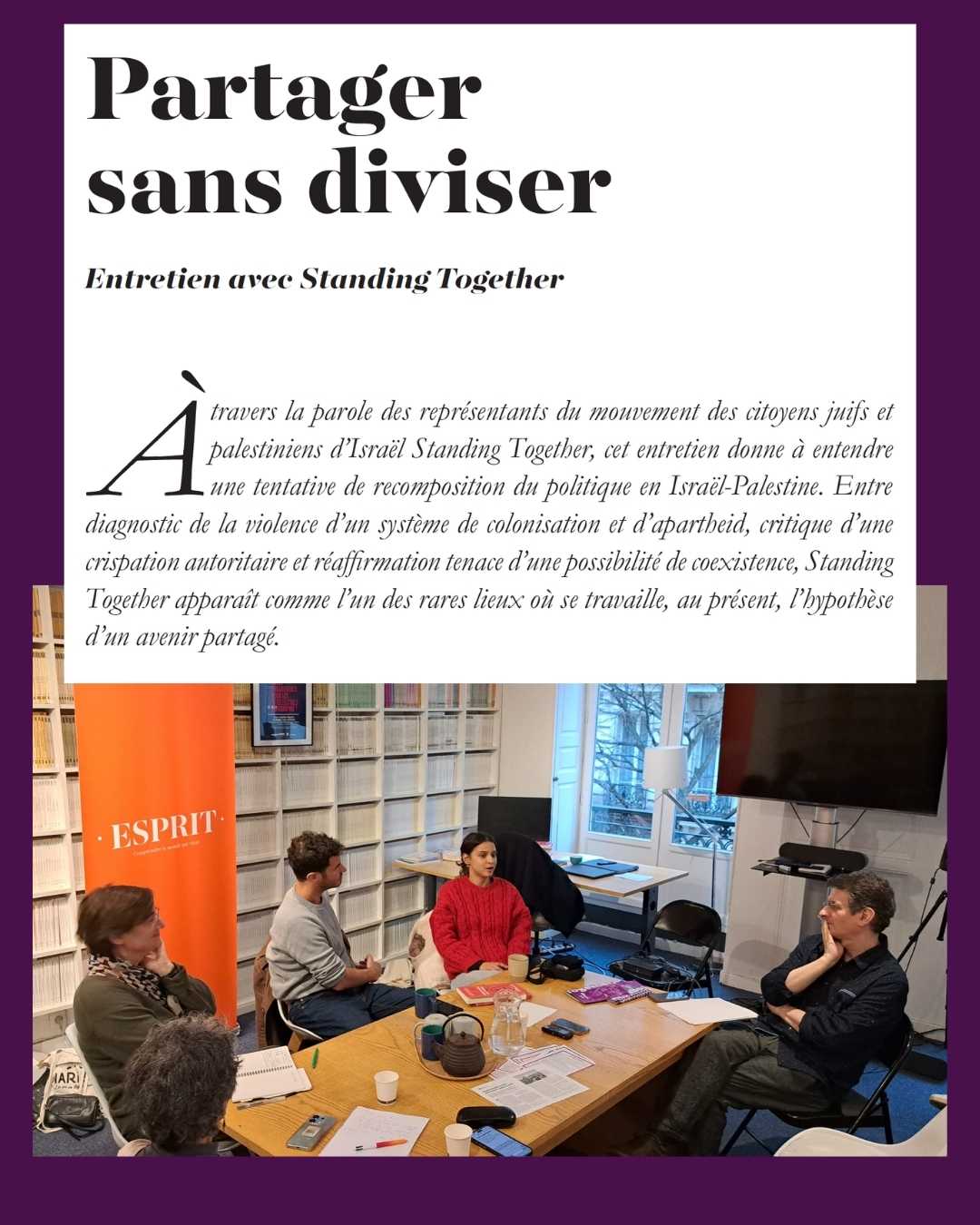
🇫🇷 La revue Esprit consacre son numéro de juin à « l’avenir à reconstruire » en Palestine – procurez-vous de ce numéro exceptionnel ici. Amal Ghawi et Itamar Avneri se sont entretenu avec Anne-Lorraine Bujon, et leur interview est désormais disponible en français, grâce à la traduction par Leonard Castritius. Ci-dessous, nous publions, avec l’aimable autorisation de la revue, la version originale de cette conversation, en anglais. Merci à Martine Cohen d’avoir provoqué cette rencontre.
🇬🇧 The journal Esprit dedicates its June issue to « the future to be rebuilt » in Palestine – get your copy of this special issue here. Amal Ghawi and Itamar Avneri spoke with Anne-Lorraine Bujon, and their interview is now available in French, thanks to the translation by Leonard Castritius. Below, with the kind permission of the journal, we publish the original English version of this conversation. Many thanks to Martine Cohen for arranging this meeting.
Sharing without Dividing
Amal Ghawi & Itamar Avneri in conversation with Anne-Lorraine Bujon (Esprit)
Revue Esprit – Could you please explain what Standing Together is and why was it founded around 10 years ago ?
Itamar Avneri – Standing Together began in the second half of 2015, but when I tell the story, I usually start in 2011, the year of the so-called “social protest” in Israel. It was our version of the Arab Spring, Occupy Wall Street, or Spain’s Movimiento 15-M. We borrowed a chant from Tahrir Square in Cairo: « Ash-shaʻb yurīd isqāṭ an-niẓām » (« The people want the regime to fall »). We adapted it to « Ash-shaʻb yurīd al-ʻadāla al-ijtimāʻiyya » in Arabic, which in Hebrew is « Ha’am doresh tzedek hevrati » (« The people want social justice »).
Ayman Odeh, who translated it, is a member of the Israeli Knesset now and Representative of one of the Arab parties in Israel, “Hadash”. It was a very historical time in Israel because we shouted it everywhere, both in Hebrew and Arabic. And when we said the people, we really meant the people. Not just Jewish or Palestinian, but all the people who lived on the land and have a right to the same things.
Yet, as a protester, I felt isolated despite being surrounded by tens of thousands of people each night: The demonstrations were completely unorganised. No one approached me or asked if I wanted to do more. So, after a few months they were crushed by Benjamin Netanyahu. Many people in my generation left the country after that.
I tried to find another path into activism and ended up volunteering at the Knesset, in the office of Dov Khenin, a prominent figure on the Israeli left. There I met others who had been part of the social protest, some of them Palestinians, some of them Jewish, but all of them citizens of Israel. We often talked about how, one day, we might have another opportunity to do things better.
Unfortunately, in politics opportunities often come as crisis. In 2015, an Intifada broke out. The Israeli media called it the “Knife Intifada” or the “Lone Wolf Intifada,” as it was less organised and involved more individual attacks. It was terrifying for Jews and Palestinians alike. There were stabbings in the streets, and civilians arbitrarily arrested people, especially women wearing hijabs, simply because they were seen as terrorists. It was horrific. And in the middle of all that, Benjamin Netanyahu, addressed the public and said very bluntly: “I am being asked whether we will always live by the sword.” He paused and added: “The answer is yes.” Of course, the words of Benjamin Netanyahu were horrible. But what was even worse was that almost no one in the Israeli political spectrum dared to challenge him.
So, with this group of activists that I met at the Knesset, we decided that if no one is going to give us this hope from above, we’ll have to build it from below. And so, on October 17, 2015, we announced an anti-occupation demonstration in Jerusalem called “We will not live by the sword, we will stand together.” That’s how the name Standing Together came to be. We expected around 500 people but in the end 3000 showed up. We then decided to organise more demonstrations, in Haifa, in the “Triangle” which is a predominantly Palestinian area adjacent to the Green Line, in the Negev and then in Tel Aviv. People just kept on coming. With the lessons of 2011 in mind, we realised that mobilisation alone wasn’t enough. We needed to create an organisation and develop a vision. That’s how Standing Together was born.
Since October 7, two things have changed. Especially with the genocide in Gaza, it became very clear to us that ending the Israeli occupation and achieving Israeli-Palestinian just peace is our life mission. This is the first and foremost thing that we have to achieve. Secondly, our membership more than doubled. I think it would have been impossible to create a joint Jewish-Palestinian initiative like Standing Together after October 7. But because the organisation already existed and because we had already experienced a period of intense violence between Jews and Palestinians inside Israel during the 2021 war on Gaza, we knew how to react and people counted on us.
Revue Esprit – There were mass demonstrations in Tel Aviv at the beginning of 2026. They were the largest protests bringing together Arab and Jewish citizens of Israel to date. However, these demonstrations weren’t covered that much here in France. Could you tell us what they were about and if you think they’re an important turning point ?
Amal Ghawi – During this protest, 100,000 Palestinians and Jews took to the streets in Tel Aviv calling on the authorities to take measures against organised crime. However, something that I realised when I went to university was that the same authorities killing Palestinians in Gaza and occupying the West Bank interfere differently in the lives of Palestinians inside Israel. More and more Palestinians here are falling victim to organised crime. Among this latter community more and more people fall victim to organised crime. While it might appear as a failure of the state or the police, for the authorities it is a feature not a failure when one Palestinian is killed by another inside of Israel. The government is very happy about it. Research shows that many of the weapons used by the Palestinian society in Israel come from the IDF.
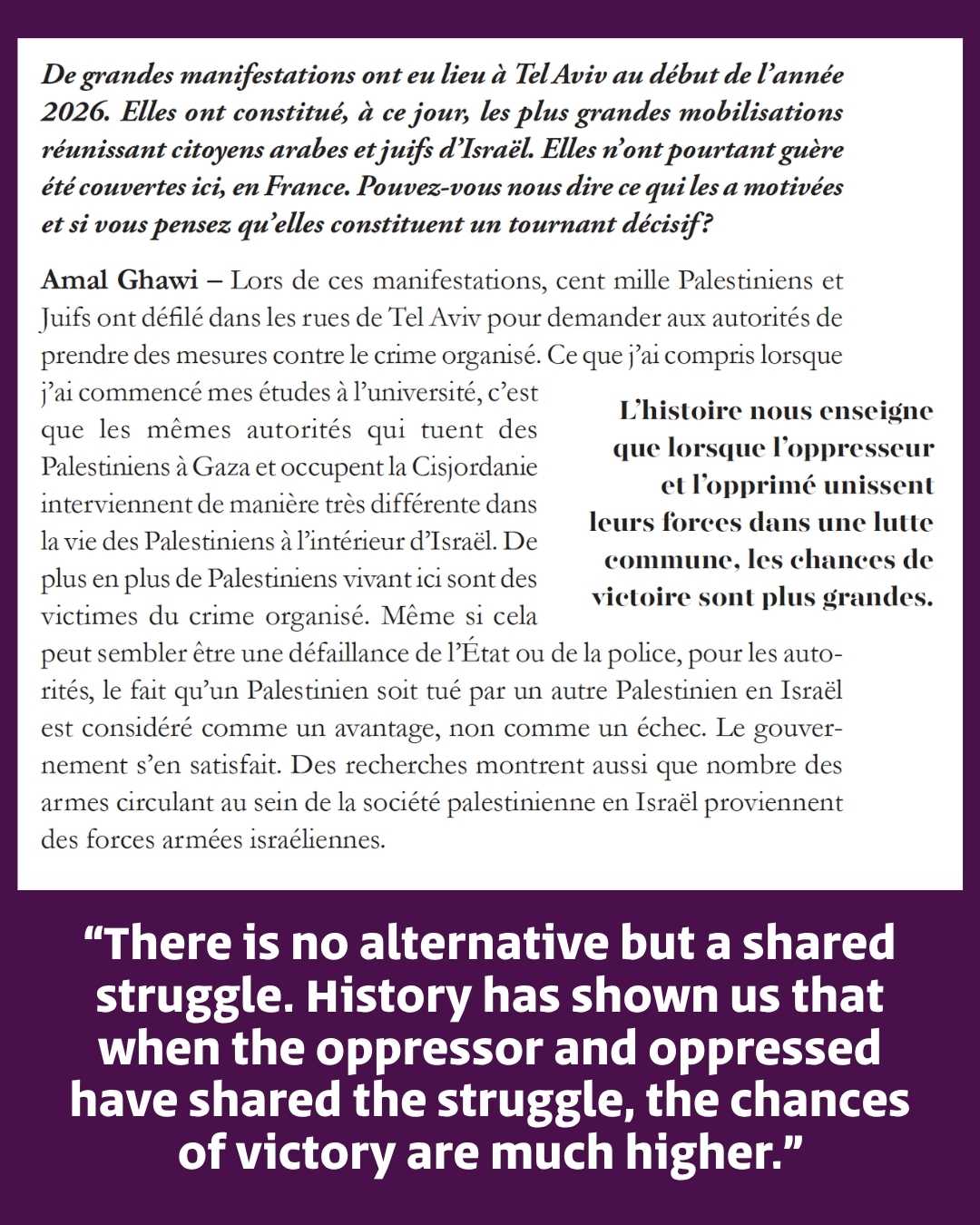
And the media isn’t reporting about it because we’re talking about Palestinian lives. We’ve all seen how complicit the media has been since October 7. It’s easier for them to say there are two irreconcilable sides. But that’s exactly what Standing Together is trying to contradict. We want to show that there is another way. That, actually, there is no alternative but a shared struggle. History has shown us that when the oppressor and oppressed have shared the struggle, the chances of victory are much higher.
Revue Esprit – You said that for the left to win in the elections today, they will have to join forces with Palestinian parties. It simply does not work otherwise, if you count the votes. So, this shared struggle will have to be translated at the political level if there should be a real chance for political change.
Itamar Avneri – It’s true. Israel is heading toward elections, though no one knows exactly when. The official date is the end of October. Right now, it looks like no party will secure a majority in the Knesset, which is necessary to form a coalition and a government. Netanyahu is far from gaining a majority again, as are the other Jewish parties. They will need to cooperate with parties representing Palestinian citizens. The problem is the inherent racism in the Israeli political sphere. Some parties have already ruled out forming a coalition with their Palestinian counterparts, which means we’ll be at a deadlock, until new elections in 2027, and Netanyahu will remain in power until then.
The formation of the Joint List, which is a coalition of Israel’s four main Arab-led parties, presents another dimension of this dilemma. On one hand, running together allows them to secure more seats in the Knesset and potentially block Netanyahu from forming a government. On the other, it requires other parties to consider cooperation with the Joint List, which many refuse. Currently, our efforts are focused on encouraging voter turnout, especially within Palestinian society in Israel. Not only because their voter turnout is lower but also to convince them of the fact that forming a joint coalition is the right thing to do for the future of Palestine and Israel.
Revue Esprit – How does Standing Together engage in dialogue with Palestinians in the West Bank or Gaza? Are there any ideological tensions regarding political power?
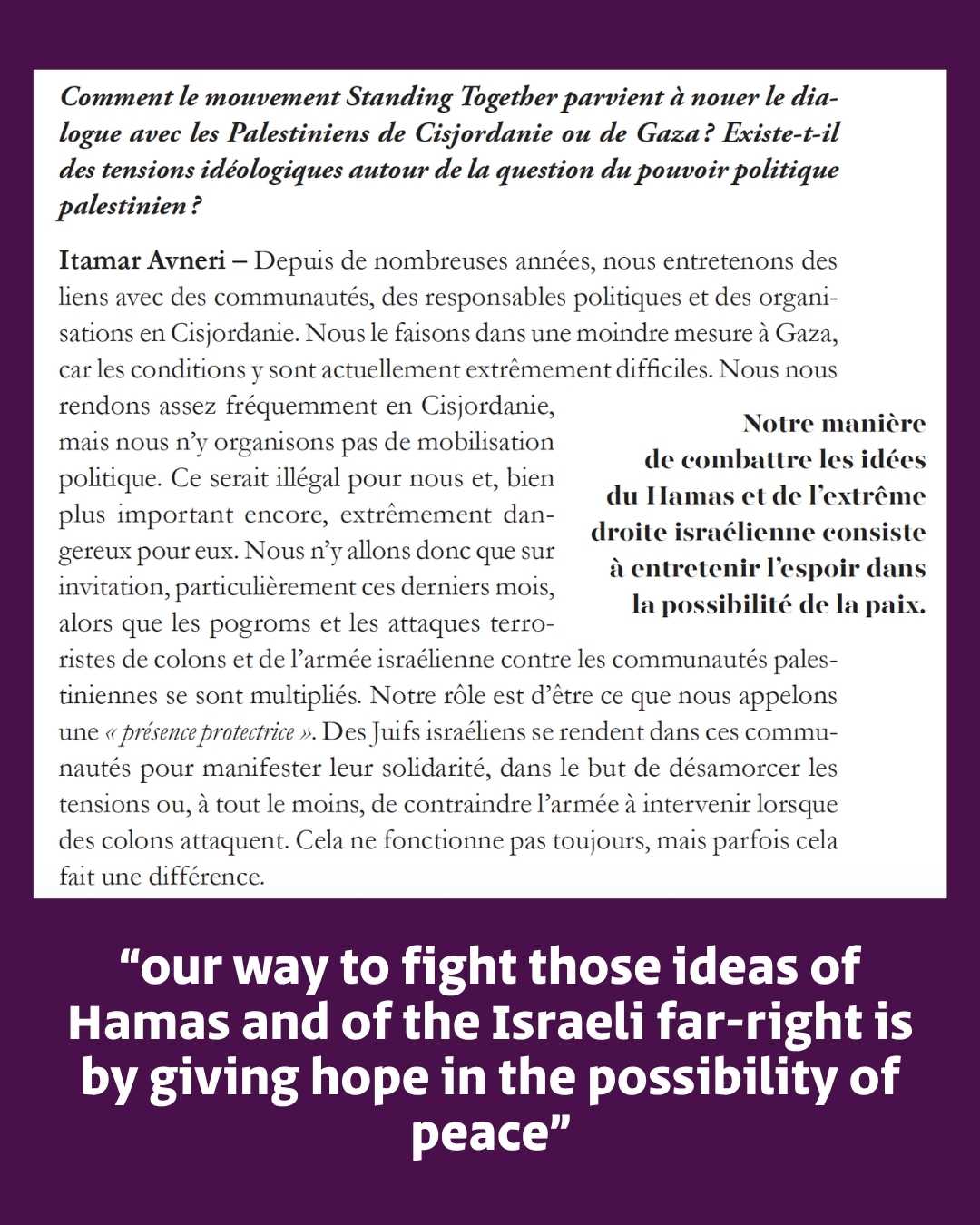
Itamar Avneri – For many years, we have maintained connections with communities, political leaders, and organisations in the West Bank. To a lesser extent in Gaza, where conditions are currently extremely difficult. We’re going to the Westbank quite frequently but we do not organise people there. That would be illegal for us but also, and much more importantly, very dangerous for them. So, we are going there by invitation only, particularly in recent months as pogroms and terror attacks by settlers and the Israeli army against Palestinian communities have surged.
Our role is what we call “protective presence”. Jewish Israelis travel to these communities to stand in solidarity, aiming to de-escalate tensions or, at the very least, compel the army to intervene when settlers attack. It doesn’t always work, but sometimes it makes a difference.
As for ideology, we have no sympathy or understanding for Hamas. However, we argue that bombing Hamas out of existence is not the solution. Even if you annihilate an entire city or region, the survivors would only emerge with deeper hatred. The weakest point in Hamas history was during the 90s and the Oslo Accords. Now, the Oslo Accords were far from perfect but at least there was some hope and the Israeli far right was very weak. So, our way to fight those ideas of Hamas and of the Israeli far-right is by giving hope in the possibility of peace.
Revue Esprit – By promoting figures such “Captain Ella” the Israeli government presents the quality of life of the Palestinians in Israel as a kind of blueprint for coexistence. To what extent is it propaganda, and to what extent does it reflect a reality?
Amal Ghawi – I want to start by saying, I don’t live in hell. It was only when the war with Iran started in June 2025, that I felt a real threat of my life. That said, if you look at any aspect of daily life, you’ll see how Israel acts like an apartheid state toward its Palestinian citizens. The government attacks anyone who doesn’t agree with its ideas. The democratic space is shrinking day by day. In Israeli hospitals, there’s a high percentage of Palestinian doctors who must stay silent about any solidarity with the people in Gaza, despite ongoing genocidal rhetoric from managers or colleagues. Palestinians also receive far less funding for their schools, and more than 50% of Palestinian society in Israel lives in poverty.
On the 9th of OctoberI knew what scenario was waiting for me. Every time anything affects the security of Israel, the first people to be targeted are the Palestinian citizens. Of course, the government can appoint a Muslim woman as an army spokesperson, but that’s just whitewashing the crimes the state commits against Palestinians in the West Bank, Gaza, and within Israel.
Revue Esprit – Does the Standing Together have a vision for “living together” in whatever form of co-existence?
Amal Ghawi – For years Standing Together said that we would accept any solution that assures dignity, security, freedom and the end of the occupation. But we’re also a democratic movement. So, two months ago we voted about what solution we think is the best due to the reality that we’re facing right now. And we voted on having a vision of “one homeland and two states”. It’s not because we think that Palestinians and Israelis cannot live together. But after the October 7 and the Genocide, reconciliation might take generations. So, as a first step, it’s best have those two states where everyone can live in dignity and in freedom.
Itamar Avneri – We need to see peace as a process. Signing an agreement would only be the beginning. Then we need reconciliation. The Jewish society in Israel, needs to face the crimes that were committed in our name, and this is impossible to do while our boots are on the neck of Palestinians and we still occupy their land. So, it will require a healing process, presumably long but maybe shorter than we think. And for this process to start, we need to give Palestinians their independence. But it is very important for us to say, that we do not speak about separation. We’re talking about a shared homeland, where we recognise that we all have a historical connection to all of the land. We’re talking about open borders and we’re talking about shared institutions. Maybe, at the end of this process, we’ll decide to live together. We see Standing Together as a sort of a time machine. We are working together as Palestinians and Jews, we speak in Arabic and Hebrew and we argue with one another. So, we know it’s possible.
Revue Esprit – Creating an example through action, not just theory seems really important in your movements. You also said that you are a social justice movement. How important do you think social justice, environmental justice and gender equality is in building this common cause?
Itamar Avneri – It’s extremely important. The environment isn’t a common discourse in Israel, even though the Middle East will be severely impacted by the climate crisis. In our vision for environmental justice, we talk about the healthcare system and hospitals, the affordability of life in our cities, the preservation of agricultural land, and about ending the occupation. I always fear the moment when Itamar Ben Gvir or another fascist minister in the Israeli government starts talking about the environmental crisis, because that would mean they’ve found yet another reason to continue the occupation and expel Palestinians. The only way to address this crisis is together. Not just Israelis and Palestinians, but everyone in the Middle East. In a way, the climate crisis can fuel the peace process. It can help us talk about shared interests.
Revue Esprit – You are traveling in several European countries to present Standing Together and participate in debates. What is your perception of these debates here in Europe? And how do you see the relationship between the Jewish and Palestinian diaspora here in France, or in other European countries?
Amal Ghawi – We’re asked about this everywhere we go. In all European countries, the issue of Palestine and Israel is deeply divisive. That’s why Standing Together is looking for supporters across Europe. But only you can determine how best to address this within your own society. What is the French perspective, especially in light of your own country’s history of colonisation? I believe everyone has a responsibility to examine their past, acknowledge wrongdoing, and ask how does this history connect to what’s happening today?
Itamar Avnery – We want people to understand that the two sides in this conflict are not what the media portrays. Not all Israelis stand behind Netanyahu’s fascist government, and not all Palestinians support Hamas. The real sides are warmongers on one side and the people on the other. Of course, I’m much safer and privileged than someone in Gaza or the West Bank – and Israel is the one occupying Palestinians. So. There is no symmetry. but in the end, we all share the same interest of ending the occupation and achieving peace.
Before October 7, we didn’t think part of our work would be to come to Europe and North America to talk about Palestine and Israel. Our groundwork remains the heart of our activity. But we understand that we need to mobilise the international community rather than wait for governments to act. The fact that my government is killing Palestinians is completely contradictory to my interests and to my future as a Jewish Israeli. We need other governments, especially in Europe and the US, to stop them. We need sanctions, boycotts of ministers, and the arrest of Benjamin Netanyahu. We want your governments to speak directly to the Israeli population and do everything to save Palestinian lives and protect all people.
Revue Esprit – One of the most significant actions of empowerment of the Israeli-Palestinian population was the humanitarian convoy.
Amal Ghawi – In August 2024, we set up a humanitarian aid campaign to Gaza. We didn’t expect many people would contribute but, in the end, we collected almost 400 truckloads of aid. Half of them went into Gaza and the other half to the West Bank.
Itamar Avneri – There was a settler organisation called “Tsav 9” (“Order 9”), named in reference to the IDF’s “Order 8,” the emergency mobilisation order for Israeli reservists. They tried to block humanitarian convoys from entering Gaza. So, we formed what we called the “Humanitarian Guard” to block them. Because of this confrontation, the police had to separate left-wing and right-wing activists to secure safe passage for the convoys into Gaza
Revue Esprit – There are even arrest warrants for two Franco-Israeli nationals, Nili Kupfer-Naouri and Rachel Touitou, for “complicity in genocide” because they participated in blockades of humanitarian aid to Gaza. Do you think such international legal pressure, through arrest warrants and the ICC, is useful?
Itamar Avneri – Absolutely. It’s important and it needed to be done. It’s about justice. And even if it doesn’t immediately help us on the ground, at least it’s also forces the Israeli media to speak about what’s going on in Gaza. Also, I think that Jewish Israelis, care deeply about what people are saying about them around the world.
If Israelis hear world leaders expressing concern for Palestinian lives, but also for their own lives, and taking action against the Israeli government for that reason, it can have a beneficial effect for the change that we are promoting. On the other hand, publications regarding legal actions against Israelis don’t have that same effect, although they must, of course, still be pursued
Revue Esprit | What can people from France or Europe do to help you fight the colonisation of the West Bank ?
Itamar Avneri – The situation is getting more and more dangerous. The Israeli cabinet has passed several resolutions that amount to a de facto annexation. They’re not only doing it by law but they’re also creating facts on the ground. This is ethnic cleansing. So, we need the international community to speak about, we need an arms embargo, we need boycotts of the settlements and sanctions against their leaders. But I would say that one of the most influential things that could be done by French and European citizens is to come to the West Bank and participate in “Protective Presence”. Especially during the olive harvest it’s always very violent. Settlers are stealing the harvest and attack the Palestinians. They carry out real pogroms. I’m talking about murders, shootings, burning houses or killing animals. So, if people from abroad would come and protect those communities, it would force the army and more importantly your governments to react. Of course, we don’t want to force anyone, but if people want to help, the best thing to do is to come and be engaged.
Amal Ghawi – People might call us a little bit insane for having hope at these times. But our motto in the movement is: “where there is a struggle, there is hope.” And we don’t believe you wake up in the morning and all of a sudden, you have hope. You must work to make it happen.
Itamar Avneri – Sometimes people ask: how do you have hope and why are you doing it? For me this is also a selfish project. I love my country. I love the landscape. I love the Hebrew language. But if I want to be free, everybody should be free on the land. And if I want to be safe, everybody should be safe. And that’s not the case right now.
So, we’re all starting from our individual interests, but also understand that no individual is an island, and no one will be free if other people on the land are unfree. And I think this the basic idea of Standing Together. We’re not doing it for the sake of history. We’re even not doing it for morale, although we think it’s the moral thing to do. We’re doing it because we want to live in this future that we are trying to create.

